Integrated biologics manufacturing is increasingly used to describe CDMOs that bring multiple process, analytical, drug substance & drug product development, and manufacturing capabilities together. But for sponsors evaluating a biologics CDMO, having these services under one roof doesn’t necessarily mean those functions are genuinely integrated.
Many European CDMOs say their teams collaborate closely, yet it’s often unclear what integrated biologics manufacturing actually looks like when critical development decisions are being made.
In this article, Dr. Barbara Fedejko-Kap, Associate VP Development, explains what integrated biologics manufacturing looks like across process and analytical development at Rezon Bio, the benefits this provides for sponsors, and the risks sponsors might face with biologics CDMOs that lack this integrated end-to-end structure.
Key Takeaways
Integrated biologics development and manufacturing goes beyond offering process development, analytical development, and manufacturing services under one roof. True integration connects these functions around a shared program and Chemistry, Manufacturing, and Controls (CMC) strategy from the outset.
- Integrated teams involve relevant SMEs early, rather than relying on formal handovers between development stages.
- Analytical and process development should collaboratively make high-impact decisions, including clone selection, process optimization, and scale-up.
- Early involvement of Manufacturing Science and Technology (MS&T) and Quality Assurance (QA) can help improve technology transfer and reduce downstream Good Manufacturing Practice (GMP) and regulatory risks.
- Fragmented development can lead to unscalable processes, insufficient analytical data, non-robust QC methods, and knowledge gaps during CDMO transfers.
- When selecting a biologics CDMO, sponsors should evaluate not only which services are available, but how the teams, data, and expertise behind those services are integrated throughout the program.
What is Integrated Manufacturing and Development in a European Biologics CDMO?
In a biologics CDMO, process development and analytical development are two closely connected operations that help take a biological molecule, such as a monoclonal antibody (mAb), enzymes or other types of recombinant protein, from early-stage concept into a robust, manufacturable product that passes regulatory scrutiny. At Rezon Bio, integration refers to connecting process development, analytical development, and other CMC functions around a shared program strategy from the outset.
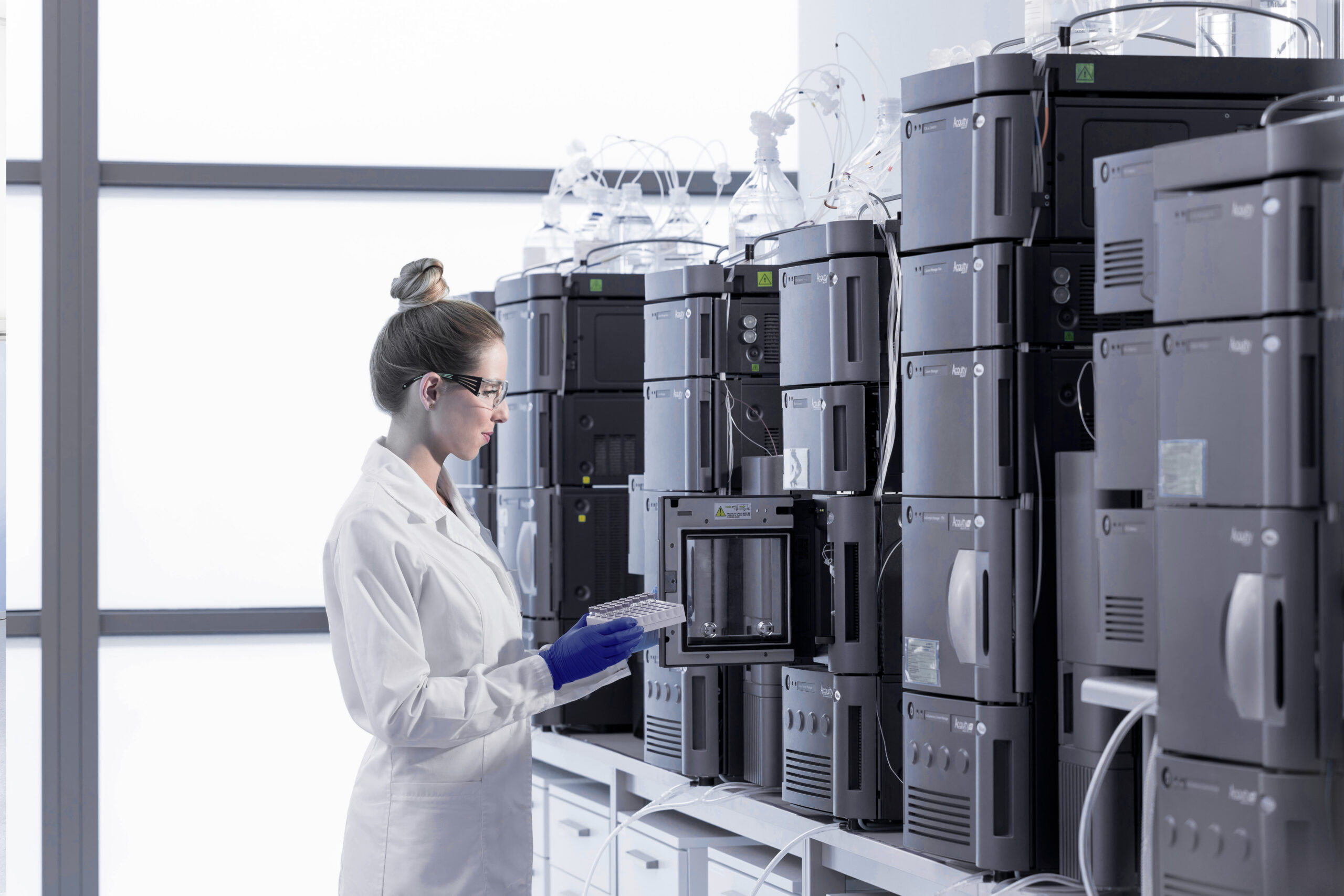
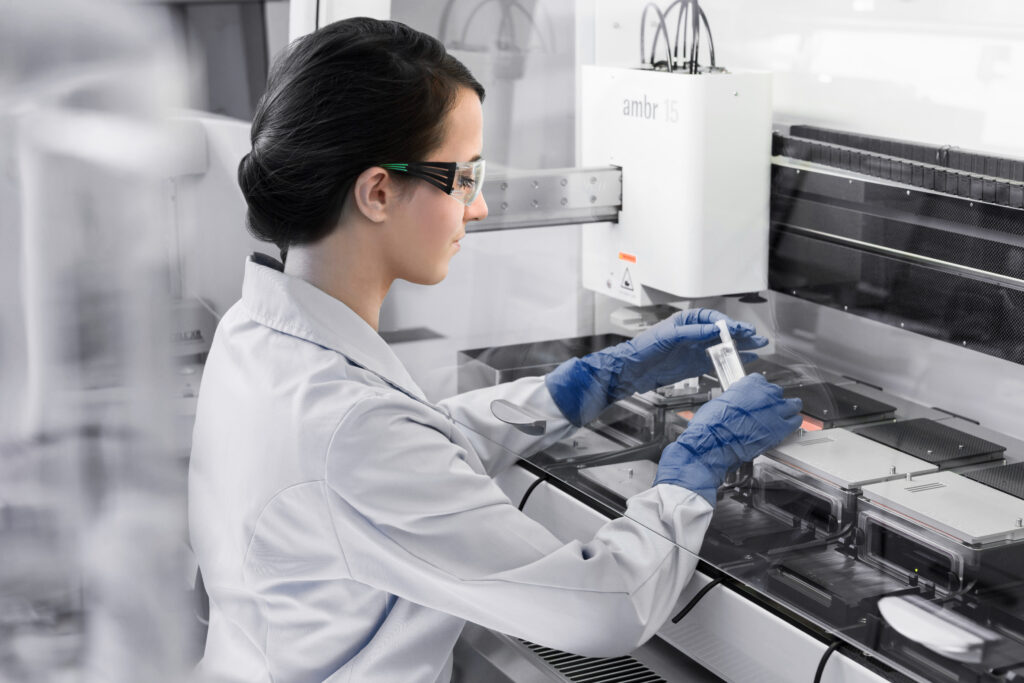
Process development focuses on designing, optimizing, and scaling the manufacturing process, while analytical development focuses on planning strategies and developing the methods used to measure and characterize the resulting biologic to confirm identity, establish potency, determine structural and physicochemical properties, and detect impurities.
Dr. Barbara Fedejko-Kap oversees analytical, drug substance process development, and drug product development at Rezon Bio as Associate VP Development. She explains what integrated end-to-end manufacturing looks like at this particular European biologics CDMO:
Our preferred model is integrated development. When we’re developing end-to-end, determining product quality is performed jointly by process and understood through analytics.
This integrated approach means different teams develop a shared understanding of the program goals and risks from the start, helping them anticipate where process changes might affect purity or other attributes assessed as critical during analytical development.
At the start of every program, the teams work closely with the client to assess the molecule, define the target product profile, and evaluate its mechanism of action. Together, we identify key program risks and define appropriate mitigation strategies. This collaborative approach also extends to establishing the Critical Quality Attributes (CQAs) and identifying process parameters that may influence them, creating a strong foundation for subsequent development activities.
In practice, this model acts as a continual knowledge loop where analytical results help inform and refine process development decisions throughout the program. As Dr. Barbara Fedejko-Kap explains: “Analytical results guide critical process development decisions – from clone and media selection to optimizing upstream and downstream process conditions and operating ranges – helping us maximize product yield and achieve the desired quality: purity and potency.”
This integrated approach extends across the full scope of client engagements. Whether supporting process development, formulation design, qualification and validation, or assays development, each project is approached with an understanding of the client’s broader development strategy and CMC objectives. This ensures that individual activities contribute meaningfully to the overall program and its path toward the clinic and commercialization.
What Integrated Biologics Manufacturing Looks Like in Practice at Rezon Bio
At Rezon Bio, integration starts with who is assigned to a program, and when. Early proactive involvement of core SMEs from different teams ensures awareness and continuity across the whole process and analytical program:
From a team-setup perspective, it means every function dedicates a representative from the outset, even at a stage where that particular function may not seem to be actively involved. This means there’s always someone following the program, picking up what’s relevant and anticipating what comes next. It’s really not about waiting for the formal handover when one work package is over and the next one starts. It’s about knowing what will come ahead.
And this cross-team integration goes deeper than broad knowledge of each development phase. It also includes early involvement from MS&T, QA and Regulatory team members, who provide input to process and analytical development teams to support streamlined technology transfer and alignment with regulatory requirements, as Dr. Barbara Fedejko-Kap explains: “It’s not only technical development, but also MS&T that is involved and providing information or challenging technical development on whether the process is sufficiently understandable and ready to be transferred. Also, from the very beginning, QA is involved to make sure that, at the right stage, the proper data are delivered with the proper governance, and that we don’t end up with a hiccup at the GMP stage. In practice, the whole integrated team agrees on what that particular study aims to deliver during execution. The team then reviews the data together to draw the best conclusions possible.”
Want to learn more about Rezon Bio’s biologics CDMO track record?
Which Teams Are Involved in Integrated Biologics Development and Manufacturing?
While exact organizational structures vary, teams involved in integrated biologics manufacturing often include:
- Process development – responsible for upstream and downstream train set-up
- Drug product development – optimizing drug product/formulation
- Analytical development – delivering methods for identity, purity, potency, aggregation, impurities, stability, and driving CQAs assessment
- Manufacturing science and technology (MS&T) – including technology transfer, scale-up of processes, deviation investigation, process monitoring, and continued verification
- GMP manufacturing – potentially including different teams for different manufacturing phases
- Quality control (QC) – supports routine testing on materials and manufactured products
- Quality assurance (QA) – to provide independent oversight to ensure phase-appropriate compliance
Is Management of a CDMO’s Integrated Biologics Manufacturing Challenging for Sponsors?
One perception sponsors might have is that integrated biologics manufacturing requires more project management effort from their side. However, in Rezon Bio’s case, sponsors still work with a single project manager as their main point of contact, supported behind the scenes by SMEs from different teams, enabling direct technical exchange among internal SMEs to limit misunderstandings and ensure effective communication with the sponsor.
There is a single customer project manager in place who is the main point of contact. But the SMEs from the functions aren’t hidden somewhere, only providing information at the back end. I value the type of cooperation where there’s SME-to-SME exchange, and not project-manager-to-project-manager exchange. Both parties know exactly what they’re talking about, and there’s no additional messenger needed
These interdisciplinary SMEs sit behind the project managers both metaphorically and physically under one roof, with clear advantages for ad hoc, coffee-break problem-solving often before issues escalate into formal deviations.
I’m really happy to see colleagues catching up by the coffee machine and discussing the issues they’re encountering. That kind of informal exchange allows information and ideas to move quickly across the team. Quite often, a problem can be understood and addressed before it ever needs to become a formal escalation.
Where Integration Creates the Most Value
Not every point in a program carries equal weight, and Barbara is specific about where cross-functional input matters most.
The greatest value is at the decision points that have long-term consequences. Achieving critical milestones should be a joint venture, a team decision.
Four of those decision points recur across programs:
- Developability assessment — evaluating how a molecule fits Rezon Bio’s platforms before development begins.
- Clone selection — weighing product quality against titer, not titer alone.
- Scale-up and tech transfer — confirming development conditions actually transfer to commercial manufacturing.
- Process characterization — building frames for successful Process Performance Qualification (PPQ) and a coherent CMC story a regulatory submission depends on
Clone selection milestone illustrates why this needs integrated, cross-functional teams from the outset, as Barbara highlights: “The highest-yielding clone isn’t necessarily the best clone for purification through downstream processing or the clone with the best profile when it comes to activity.”
Ultimately, an upstream process development team optimizing for yield alone, without analytical input on downstream behavior and activity profile, can select a clone that may be suboptimal for transfer to manufacturing-scale conditions, thus wasting both time and money.
What Are the Risks of Fragmented Biologics Manufacturing and Development?
Barbara is direct about the cost of separating these functions, whether across internal silos or across different CDMOs entirely.
Working in silos can cost both time and money. Having separate functions means process development can choose conditions without having the full analytical data in place, and they may not be the best conditions. Manufacturing may then receive a process that isn’t really scalable, or that’s difficult to operate at commercial scale, while QC may end up with methods that aren’t robust enough. Bringing these functions together early helps identify and address the risks before they become costly challenges later in development.
One concrete example of what can occur when process and analytical teams aren’t effectively integrated is that test material can simply run out without proper oversight.
If different teams use inconsistent sample handling, we can end up with an insufficient amount of retained samples for later comparability. For example, the process team changes something, and then analytics doesn’t have enough material left to analyze it.
Internally, these problems are inconvenient and have real knock-on effects on development timelines and broader programs. Yet when a program moves between two or more CDMOs mid-stream, the problem compounds, as Barbara highlights: “The biggest struggle is getting the development data from the CDMO that was previously working on a project. When all the relevant functions are under one roof, continuity becomes much easier to manage, with knowledge shared directly across teams and carried forward throughout the program.”
Questions to Ask a European CDMO About Their Integrated Biologics Manufacturing
In practice, Barbara highlights seven questions worth putting to any biologics CDMO on a shortlist:
- Who owns the development strategy for this program?
- Will we have a single point of contact only, or direct SME access across functions?
- How is data exchanged internally, and how is it shared with us?
- How is the scale-down model connected to manufacturing and commercial equipment?
- How is analytical development connected to QC in terms of method transfers?
- Is there one common documentation system across functions, or several incompatible ones?
- How are deviations and unexpected results investigated across functions and communicated to a sponsor?
And Barbara’s advice for sponsors evaluating a CDMO’s development organization also goes beyond what’s generally published on a website or LinkedIn profile: “I’d definitely recommend a due diligence or a preliminary site visit. It gives sponsors the opportunity to look beyond capabilities on paper, to meet the people who will actually support their program, understand how the teams work together, and experience the organization beyond the structure shown on an organization chart.”
The answers to these questions should provide insight into a biologics CDMO’s internal workings, which is useful for sponsors evaluating partners. Different sponsor requirements will need different answers. For instance, separate teams reporting through separate channels isn’t necessarily a negative for every program, but comprehensive integration generally gives sponsors and projects far more advantages than disadvantages by limiting overall risk.
Need more guidance on choosing a biologics CDMO?
Organizational Integration Connects Expertise
Simply having process and analytical teams under one roof isn’t enough. True organizational integration means many different teams work together early on and throughout the development and manufacturing pipeline to connect expertise and reach the common CMC goal. It’s essential for sponsors to understand how those services and the experts behind them are connected throughout the program.
For instance, one scenario could be the following: Analytical development identifies a critical quality attribute ↔ Process development identifies which process parameters influence it ↔ MSAT ensures that knowledge transfers into manufacturing ↔ GMP operations execute the process ↔ QC verifies the product ↔ QA ensures everything meets GMP requirements.
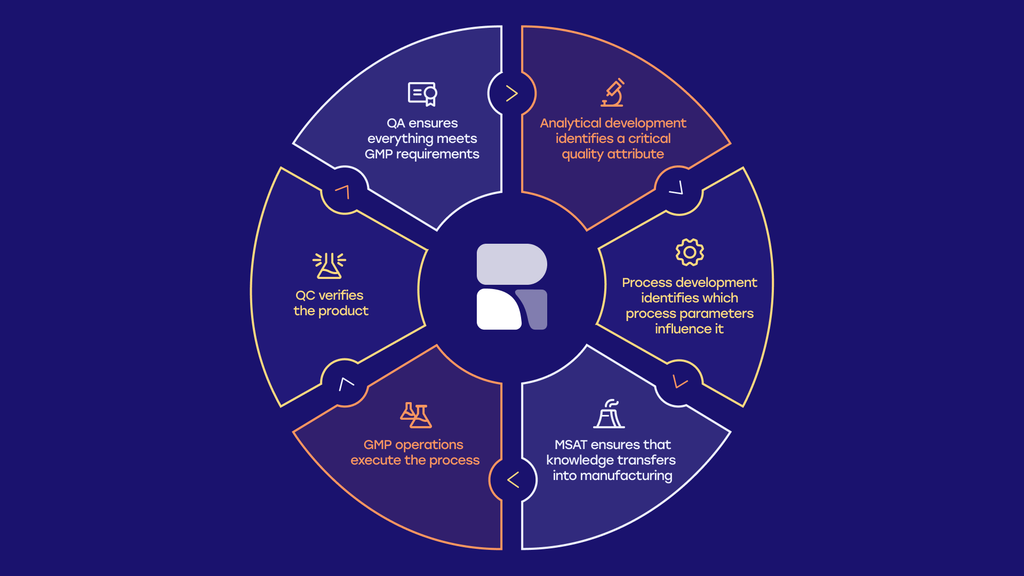
Ultimately, integrated biologics manufacturing connects development, analytics, technology transfer, and GMP operations into a coordinated workflow, reducing handoffs and helping move programs from molecule to manufactured product more efficiently. For sponsors selecting an integrated biologics manufacturing partner in Europe, the question is not simply which services a CDMO offers. It’s how those services—and the experts behind them—are connected throughout the program.
Planning your biologics development program?
Dr. Barbara Fedejko-Kap is Associate VP Development at Rezon Bio, where she leads the technical, strategic and operational planning of development programs. Her focus lies in optimizing value, time, resources and risk across the biologics lifecycle.
With a strong academic foundation and 15 years of industry experience, Barbara combines scientific expertise with a strategic development mindset to accelerate the delivery of biologic medicines from concept to patient. She focuses on translating science into product value by incorporating manufacturing, quality, and regulatory perspectives to development processes to enable successful and efficient product realization. Her experience spans the full biologics development lifecycle, from early-stage development and technology transfer to commercialization and lifecycle management
Barbara holds a Ph.D. in Biotechnology from the Gdańsk University of Technology and is currently expanding her business expertise through participation in an Executive International MBA program, strengthening her leadership perspective and strategic insight within the life sciences industry.