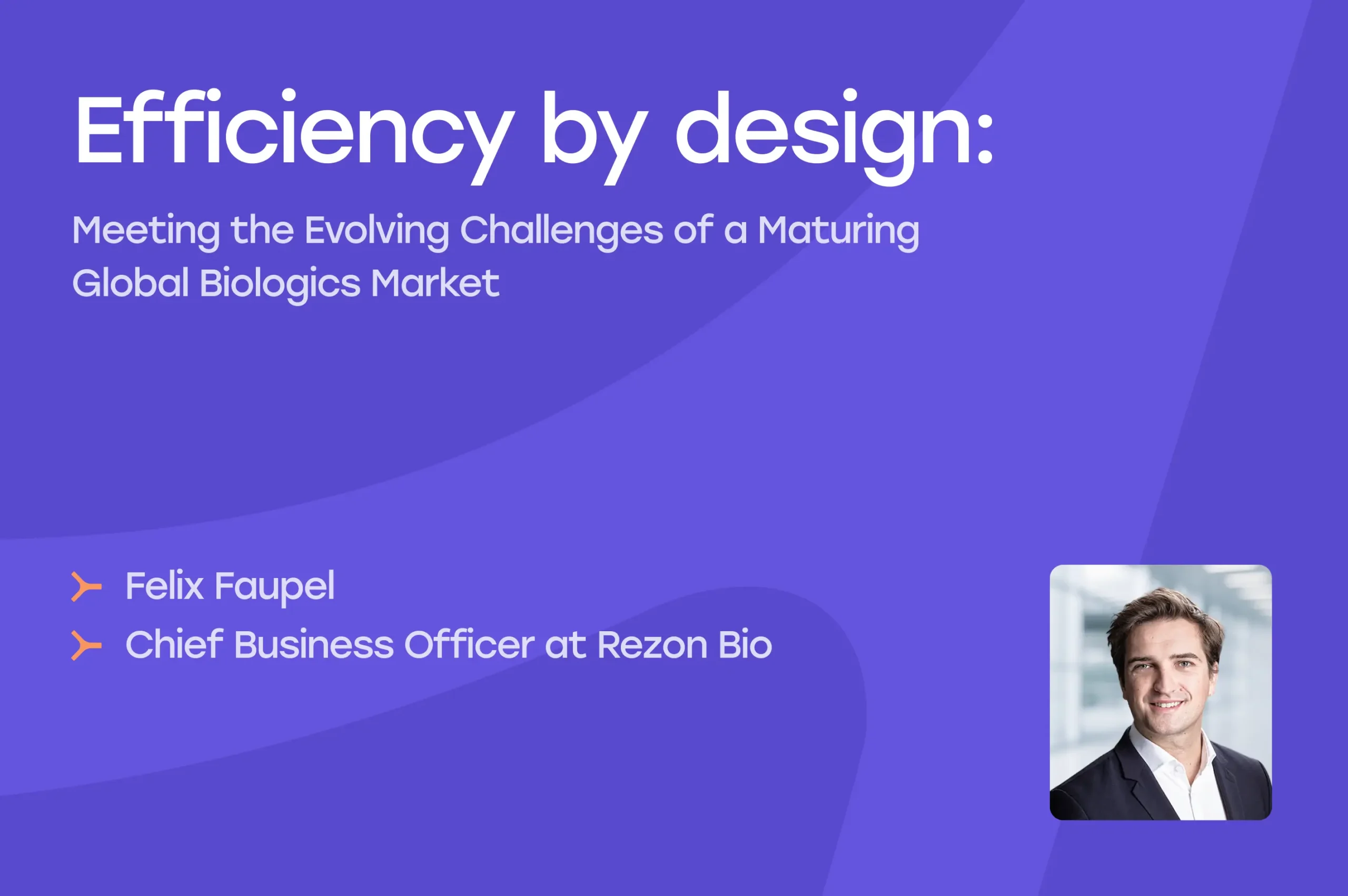
Author: Felix Faupel, Rezon Bio
Rezon Bio is evolving from its origins within Polpharma Biologics’ biosimilars business into a full-fledged midsize global CDMO, leveraging world-class facilities, an experienced leadership team, and a service-first culture to meet the changing needs of biologics development and commercialization. In this Q&A, Felix Faupel, Chief Commercial Officer, explains how the company is positioning itself in a maturing market, balancing cost and quality, and building client partnerships rooted in trust and efficiency.
Q: To begin, could you introduce yourself and share a bit about your background — both your experience before joining the company and your role today?
A: I joined Polpharma Biologics in January to help guide the launch of Rezon Bio, a new, standalone CDMO business. My role was created to strengthen the commercial side of the business, which had been missing.
Before this, I held commercial roles across biotech CDMOs across a range of modalities — from small molecules and peptides to live biotherapeutic products. Most recently, I spent four years as Chief Commercial Officer at Bacthera, working in the microbiome field. That sector is incredibly challenging, but also rewarding — I met fantastic scientists, built close networks, and really felt the sense of community there.
Across these experiences, I’ve seen the full spectrum of industry maturity: from the early days of live biotherapeutic products, through the very established and cost-pressured world of small molecule generics, to the middle ground with peptides. Now, stepping into biologics, I see an industry becoming more standardized and moving toward commoditization. That’s a positive sign — it means efficiency is increasing, expectations are shifting from “just get me the product at any cost” to “is this reasonable and sustainable?” I love that evolution, and I think it makes this a perfect moment to enter the biologics space.
What I bring to the new company is deep expertise in CDMO sales. The fundamentals of CDMO business are consistent across modalities: it’s about service, client satisfaction, reliable delivery, and being competitive on multiple fronts. In my past roles, I’ve built CDMO teams, developed offerings, and taken part in leadership decisions from both the commercial and technical sides. At Rezon Bio, I’m now part of the leadership team shaping our CDMO strategy and ensuring clients have a strong offering, great service, and a positive experience working with us.
Q: Can you share a bit about the inspiration behind the launch of this new CDMO business?
A: The story is quite straightforward. We come from the biosimilar sector, and within that space we built two truly exceptional facilities. During a recent visit from a Big Pharma client, she told us it was the second-best site she had ever seen. That kind of feedback confirmed what we already knew — our manufacturing assets were world class.
With those facilities, we realized we could go beyond simply supporting our own pipeline. We also have extensive adjacent space to add new lines, and we’ve already demonstrated we can scale, having secured approvals from the U.S. FDA, EMA, ANVISA, MHRA, and others. The infrastructure and team were already in place.
One of the key visionaries here was our supervisory board member, Konstantin Matentzoglu. With his deep CDMO background, he recognized the potential to leverage what we had far beyond biosimilars. Of course, biosimilars remain important, but the opportunity was to expand into true CDMO services — producing not only our own products but also those of sister companies and third-party clients. That’s the seed of the idea and the foundation of the transition we’re now pursuing.
Alongside players like Northway Bio and Mabion, which we take seriously, there’s still space for a strong, cost-competitive CDMO in Europe. That’s the position we’re aiming to fill.
Q: As Rezon Bio begins to mature as a CDMO, how would you describe its identity, personality, mission, and vision?
A: When it came to developing the brand, our priority was to earn the trust of the industry while also differentiating ourselves clearly. We want clients to know that we care deeply about their products, that we bring real dedication to the table, and that dedication translates into quality and value. Even visually, we wanted to go beyond the usual “CDMO blue.” Instead, we chose bold purples and warm oranges — colors that feel human, ambitious, and energetic, like a sunrise signaling a new chapter.
The brand reflects the feeling we want people to have when they work with us: that the partnership is engaging, positive, and even fun while still being serious as we tackle challenges together. That extends to the way we communicate. We deliberately avoid the tired clichés you hear everywhere in this industry. Instead, we want to speak plainly: we’re here to make your life easier, to move quickly, to be cost-competitive, and ultimately to deliver real value.
Our goal is for clients to not only get strong results, good terms, and reliable delivery but also to have a genuinely positive experience partnering with us.
We believe that Rezon Bio is debuting with the best of both worlds — the infrastructure and regulatory track record of a larger company but the agility of a smaller one.
We feel that our ownership is another differentiator that offers real benefits to clients. Many CDMOs backed by private equity are under constant pressure to deliver quick returns. That often translates into squeezing clients, cutting corners, or chasing short-term wins before flipping the business for a profit.
Our situation is different. As we are controlled by a successful private entrepreneur with long-term vision, we have significant financial stability without that pressure for a quick exit, which grants us the freedom to focus on building long-term partnerships rather than chasing immediate gains. For clients looking for a truly trusted partner, I think that positions us very strongly.
Q: I’d like to ask about balancing high standards of quality and compliance with cost competitiveness. What elements are key to maintaining the balance — staying competitive on cost without compromising quality and compliance?
A: It really is about balance. I was just thinking yesterday about the classic triangle of time, quality, and cost. Some people say you can only ever have two of the three, but I don’t agree. With the right approach, you can fine-tune all three.
Because we’re not private equity owned, we’re not forced into short-term thinking. At the same time, we’re working hard to stay agile. We benchmark ourselves continuously against the industry — in operations, sales, and project management — so we know we’re staying competitive, not for the sake of a short-term exit strategy but because it’s essential for our long-term success.
Another advantage is our location. Poland offers a naturally competitive cost structure, despite being a higher-wage economy compared with some regions. On top of that, Poland’s economy has been one of the strongest in Europe in terms of growth. That solid infrastructure and momentum give us a foundation to combine speed, cost efficiency, and quality.
Our roots in the biosimilars sector also shaped this mindset. Biosimilar development demands speed — especially now with phase III waivers accelerating timelines in the United States — but never at the expense of compliance. That’s why we describe our approach as “uncompromised quality.” We’re committed to quality systems that keep operations safe and ensure patient protection, but we do so pragmatically. We don’t need to build a “Rolls Royce” of quality systems if a right-sized approach delivers the same security more efficiently.
This pragmatism enables both speed and competitiveness. By continuously benchmarking and optimizing, we’re meeting client expectations and market demands — and ultimately delivering on all three pillars: time, quality, and cost.
Q: Can you expand on the advantages of being a Polish company today? And do you think the wider perception is aligned with reality?
A: From what I’ve seen at conferences, there is a strong interest in manufacturing pharmaceuticals in Poland or Eastern Europe in general: people are intrigued and excited. Competitors like Northway and Mabion certainly helped in paving the way to proving Poland and Central Europe as a whole can be credible players in global CDMO markets. But I believe we can go further. In my view, we offer a more reliable supply track record and a higher level of customer service, which sets us apart.
Poland in 2025 is not the Poland of 2005. It has become a major pillar of the European economy — one of the strongest nations on the continent. Poland may not have the same long biotech history as Switzerland, Germany, France, or the UK, but it is building its own footprint and a strong legacy. At Rezon Bio, we’ve combined external expertise with the cultivation of local talent. Our staff now includes professionals with tremendous experience in biopharma manufacturing, which has created a strong and sustainable knowledge base.
There’s also a cultural element I find very important. The work mentality in Poland is a real differentiator. People here are highly dedicated and willing to go the extra mile for clients. Compared with some Western European countries, the drive and ambition in Poland stand out.
When you combine those “soft” factors — dedication, work ethic, service mindset — with the “hard” ones like cost structure, infrastructure, policies, and global reach, you get a very compelling case for why producing in Poland is not only viable but advantageous. And that message is being received favorably.
Q: Do those cultural values also translate into staff retention and organizational continuity?
A: Absolutely. Even though we’re in the middle of building a new CDMO business — which naturally brings some new challenges to the organization — our overall retention has been strong. We’re holding on to the key talent we need, while the transformation itself has opened opportunities for people to step up and take on more responsibility. Over the past several weeks and months, we’ve seen many of our team members grow into larger roles, which has been very positive for both them and the company. In general, we see a lot of excitement within our teams about entering the world of CDMOs and taking on the established players in the market. It triggers the competitiveness in us to be better.
Q: Your sites are in historic university cities with long academic traditions. Does that extend to biomanufacturing — are there strong local feeder programs from universities that help build your workforce?
A: Absolutely. We have very strong collaborations with local universities on several levels. We also bring in many people directly from universities or through apprenticeship programs, then train them internally. That combination has given us a strong talent pipeline.
On a personal note, I’m German and live in Switzerland, so I could have chosen to work for companies there, but I decided to join this team because I truly believe in what this company is building. I love the story, the capabilities, and the potential — and that includes the knowledge base we’re creating through these academic collaborations and training programs.
Q: What do you see as your sweet spot in terms of customers? Is there a particular type of client that benefits most from working with you, or a segment that makes the most sense to engage with first strategically?
A: There are really three areas where I think we can add the most value.
The first is biosimilars. Historically, most biosimilar companies built their own programs and facilities, so there weren’t many opportunities for CDMOs. But that’s changing with the new phase III waiver, which is creating more virtual biosimilar companies that will need external manufacturing partners. We’re very well positioned to ride that wave.
Second, and just as important, is late-stage transfers. We’ve already done this ourselves — PPQs (process performance qualifications), PAIs (pre-approval inspections), commercial manufacturing, and multiple product launches across different regions. That’s unique for a company of our size. Most midsize CDMOs can’t claim that experience; usually, only the largest players like Lonza can. But for products that aren’t blockbusters — say, 20 or 30 batches a year — midsize companies like us are generally the best fit. We bring proven commercialization experience and state-of-the-art, approved facilities but without the premium pricing or the feeling that a smaller client is getting lost in the shuffle. For companies that don’t want to go to China or India but also don’t want to pay a Lonza-level premium, we’re a very compelling option.
And third, we have an outstanding development setup. Biosimilars demand extremely strong analytical development, and our team excels there. We have state-of-the-art labs, AMBR platforms, and the ability to scale processes quickly — cutting timelines without cutting output. That also positions us well to support early-stage projects, where we can work strategically with clients on both pricing and timelines. Building a healthy pipeline is important for us, and we have the teams and capacity to take it on.
Ultimately, whether it’s new biosimilar players, companies transferring late-stage assets, or strategic early-stage collaborations, we have a strong case in each of those spaces.
People often ask: What makes you different? What’s your unique selling proposition? And honestly, it’s not one single “crazy, fantastic” thing. Other midsize players have done commercialization before. It’s not about one magic bullet — it’s about the combination.
We bring together experience, a proven track record, cost competitiveness, and the mentality of our team — the drive and dedication that really define us. That combination is what’s unique. Too often you see companies with good costs but poor service, or great service and quality but at a massive premium, especially when private equity ownership is involved.
Our approach is to support the industry in a balanced way: reasonable costs, reliable delivery, and uncompromised quality. That ensures our clients can succeed with their products in the market, while also maintaining a sustainable cost structure. If you look at the environment we’re in — whether under the current U.S. administration, in Europe, or specifically in biosimilars — one thing is certain: prices will continue to go down instead of going up. As a player in this space, we have to adapt to that reality, and we’re well positioned to do so.
Q: Biologics manufacturing is reaching a stage where it’s not yet fully commoditized but is clearly moving in that direction. Has that shift in maturity influenced the operational or structural decisions that Rezon Bio is making? Are you positioning yourselves differently than you might have if you’d entered the space earlier?
A: From my time in generics, I learned that when prices are calculated in decimals, you need to be in absolute control of every aspect of your operation. In contrast, when you’re in an innovative space, it’s more about speed — getting the product out, generating revenue, and fixing the structure later. That made sense in the past and in that context.
In more commoditized industries, like what biologics is developing toward, the only way to succeed is through efficiency. Higher titers help, of course, but there are other differentiators (e.g., how quickly you can produce, how fast you can take on new projects, and how effectively you can run your plant). We’re structured for speed — we work exclusively with single-use systems, leverage the latest technologies, and are building processes with full transparency and control.
This is what excites me about the timing. As we transition from being a captive operation to a CDMO, we can design our systems, processes, and data structures from the ground up. That means we’re not burdened by legacy inefficiencies — unlike some competitors who now have to retrofit or overhaul existing systems. We can be efficient by design, which is a real advantage.
Another important piece is mindset. In biosimilars, companies often plan from cell line to commercial launch with cost efficiency baked in from the start. I think that same mindset should apply to novel biologics too, even if clients themselves aren’t always focused on it — they may just be chasing the next value inflection point. By having a development platform that integrates the right cost structure early, we can set our clients up for success all the way through commercialization. That’s the kind of forward-looking approach we believe will really help our partners.
Q: How do you see the company evolving over the coming years, and do you have clear milestones in mind along the way?
A: This is actually my third CDMO startup journey, so I know it takes time to become a recognized player with enough products and sufficient titers. It never happens overnight. The advantage we have is that our facilities are already up and running, producing for Polpharma Biologics’ biosimilar business. That gives us a strong foundation. We don’t need 20 quick wins just to survive, which means we can focus on entering the market in the right way — with the right approach, messaging, clients, storytelling, and offers — and then execute those projects properly. What we want to avoid is signing 20 projects at unsustainably low prices and then struggling to deliver.
In the CDMO world, trust is the number one currency. If you mishandle your first project, you lose credibility, and it can be very hard to recover. The priority is to deliver a very high level of client satisfaction from the start.
Beyond that, the potential is huge. If demand grows as we expect, we already have a surge manufacturing line that can be deployed quickly, and we have the capacity to expand up to seven manufacturing lines across different buildings if needed. Financially, we’re in a good position as part of a strong group of companies with an owner who believes in this business. If our case proves out, we can grow further.
We want to grow together with our clients, scaling in a way that matches their needs and ensures stability along the way.
Q: Are you leveraging AI and other digital tools to drive efficiency and create value for clients?
A: Digitalization and AI are central to how we’re building efficiency into our operations. For example, on one of our lines we’ve implemented a digital twin, and for a specific process it allowed us to increase output by a factor of four. That’s exactly the kind of impact we want to deliver for clients.
The approach is straightforward: we run the batches, collect the data, and then use the digital twin to model and test how we can further optimize performance. Those insights allow us to make the process more efficient, which ultimately lowers costs for our clients. It’s a powerful tool for ensuring we’re not just meeting expectations but continuously improving outcomes and making products more affordable.
Q: As you continue building the business, are you establishing any strategic alliances that support your growth and positioning?
A: Partnerships are part of our DNA, shaped by our legacy in biosimilars, where collaboration is essential. We’re very open to working with partners toward joint goals, and there are a few types of alliances that are especially important for us.
One category of partnerships extends our business offering. For example, we work with specialized external partners who can sometimes do a job better than if we handled it fully in-house. We also have our own drug product development team, and based on our past experience, we can manage third-party GMP manufacturers effectively. That allows us to expand our scope and provide clients a broader, more flexible offering.
Another category is about responding to broader industry needs, particularly the trend toward supply chain “regionalization.” We’re a European-based CDMO and can serve clients globally, but we also recognize the growing importance of regional manufacturing. That’s why we’re open to collaborations with other regional players in China or in the United States.
For midsize CDMOs like us, these kinds of partnerships are critical. Big players like Lonza can cover the U.S., Europe, and Asia under one roof. But midsize companies and their clients don’t always have that luxury. By working together, regional CDMOs can create a compelling, globalized offering while still maintaining the agility and cost advantages that make midsize players attractive.
Q: Can you expand on the experience you want clients to have working with you?
A: For us, it’s all about creating a positive, reliable experience. Think of it like going to a restaurant — you want good service, you want to enjoy yourself, and you don’t want sleepless nights worrying about whether the meal will show up or whether it will be any good. In our world, that means clients shouldn’t have to fear that a batch will fail, be delayed, or that we’ll deprioritize them in favor of something more profitable. When we commit to a project, we deliver it.
Being midsized gives us an advantage here. Clients have direct access to key people — senior staff, scientists, project managers — which makes the relationship deeper and more transparent than they might get at a giant CDMO. At the same time, we don’t just say “yes” to everything; we aim to be a partner whose judgment, integrity, and sincerity clients can trust.
When you bring all of this together — our track record, cost competitiveness, service mindset, growth potential, and financial stability — none of it alone is extraordinary, but in combination it’s very powerful. As I like to say, it’s a bit like the Power Rangers: individually strong, but when they come together, that’s when they’re truly extraordinary.
About the Author
Felix Faupel, Chief Business Officer at Rezon Bio
Felix Faupel is the Chief Business Officer at Rezon Bio, responsible for driving the company’s global commercial strategy and client partnerships. With more than a decade of experience across the biopharmaceutical and CDMO sectors, Felix brings a unique combination of scientific understanding and business acumen to help clients navigate the complexities of biologics development and manufacturing.